⋆。°✩ MAKING U-M MAKERSPACES MAKE SENSE ✩°。⋆
MAKING U-M MAKERSPACES MAKE SENSE
ROLE: UX Researcher & Designer | TIMELINE: May 2025 - Present
TOOLS: Dovetail, Figma
ROLE: UX Researcher & Designer | TIMELINE: May 2025 - Present
TOOLS: Dovetail, Figma
A student-led research effort to redesign how University of Michigan students discover, access, and safely use campus makerspaces.
SKILLS & METHODS: Qualitative Research & Interviewing, Thematic Coding, Insight Synthesis, Human-Centered Design, IA, Wireframing
U-M has one of the largest collections of student-accessible makerspaces in the country, yet access remains difficult. Information about tools, training, certifications, reservations, and safety procedures is scattered across disconnected systems, which leaves students confused, resources underused, and staff stretched thin. I led qualitative research with students and makerspace staff, then translated those findings into early design directions for a centralized digital platform.
U-M has one of the largest collections of student-accessible makerspaces in the country, yet access remains difficult. Information about tools, training, certifications, reservations, and safety procedures is scattered across disconnected systems, which leaves students confused, resources underused, and staff stretched thin. I led qualitative research with students and makerspace staff, then translated those findings into early design directions for a centralized digital platform.
TEAM: Cross-functional student team in partnership with U-M makerspace staff
I planned and conducted qualitative interviews with undergrads from multiple majors (Wilson Center, FRB, Duderstadt Audio Studio) and with makerspace staff responsible for training, safety, and operations. I structured the interviews around how students discover spaces, training and certification confusion, scheduling, mentorship, and staff workflow fragmentation.
I planned and conducted qualitative interviews with undergrads from multiple majors (Wilson Center, FRB, Duderstadt Audio Studio) and with makerspace staff responsible for training, safety, and operations. I structured the interviews around how students discover spaces, training and certification confusion, scheduling, mentorship, and staff workflow fragmentation.
Semi-structured interviews with students across majors and makerspace staff. Conversations covered discovery, training confusion, scheduling, mentorship, and operational pain points.
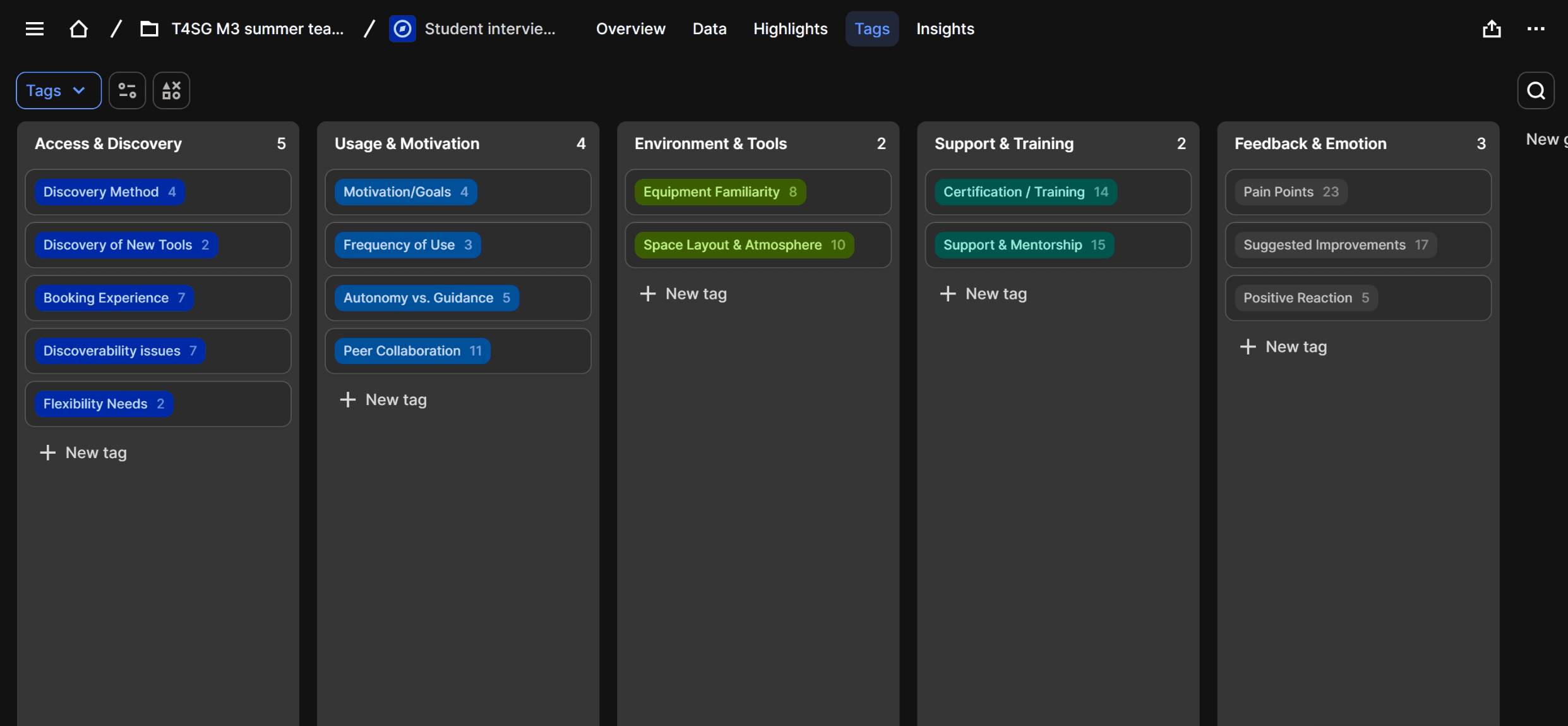
Tags, highlights, and affinity groupings in Dovetail. Cross-cut student and staff perspectives to surface patterns that repeat rather than isolated complaints.
Translated coded data into user group profiles and ranked insights by MVP impact. Each insight tied to a concrete design implication.
Synthesis surfaced four recurring patterns across the makerspaces, clear repeated problems rather than one-off feedback.
Synthesis surfaced four recurring patterns across the makerspaces, clear repeated problems rather than one-off feedback.
MAKERSPACES ARE BUILT TO BE USED, BUT NOT TO BE FOUND
MAKERSPACES ARE BUILT TO BE USED, BUT NOT TO BE FOUND
MAKERSPACES ARE BUILT TO BE USED, BUT NOT TO BE FOUND
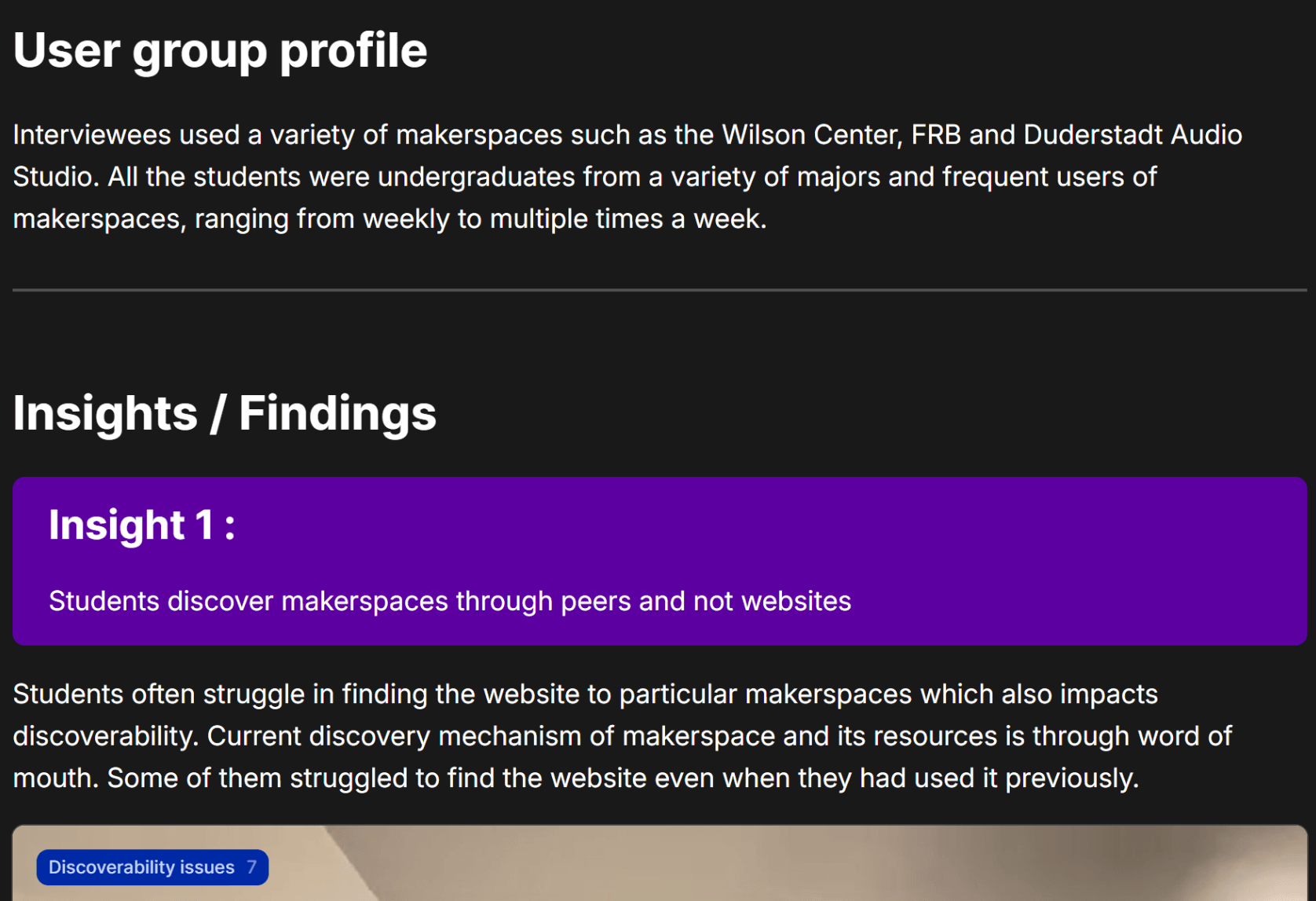
Students learn about makerspaces from peers, not websites. Even returning users couldn't find official sites.
Students don't know which trainings are required, in what order, or what each unlocks.
Students prefer mentors and peers over AI but can't find existing Slack, Discord, or GroupMe channels.
Booking systems are rigid. Students want transparency on wait times and team coordination.
Students don't need more tools. They need clearer paths to the ones the campus already has.
Students don't need more tools. They need clearer paths to the ones the campus already has.
Students don't need more tools. They need clearer paths to the ones the campus already has.
Make access make sense. Surface what's already there before building anything new.
Make access make sense. Surface what's already there before building anything new.
Make access make sense. Surface what's already there before building anything new.
I translated research findings into UX principles and early designs that make it clear who can use what, where, and how. Reduce reliance on word-of-mouth, support staff workflows without adding cognitive load, and design for both open and restricted makerspaces.
DOVETAIL TAGGING: thematic coding across student + staff interviews
INSIGHT EXAMPLE — pattern surfaced through synthesis
INSIGHT EXAMPLE: pattern surfaced through synthesis
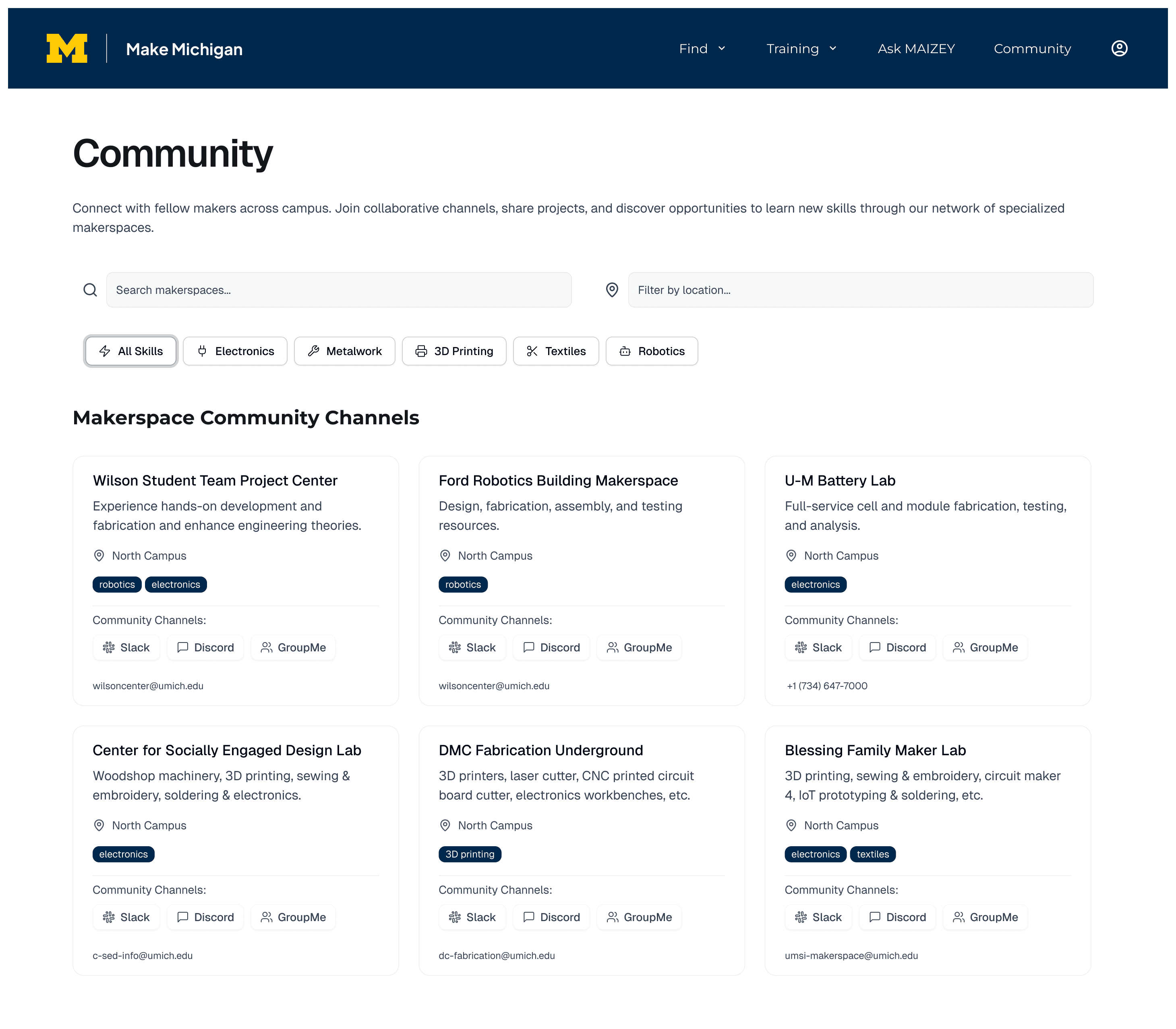
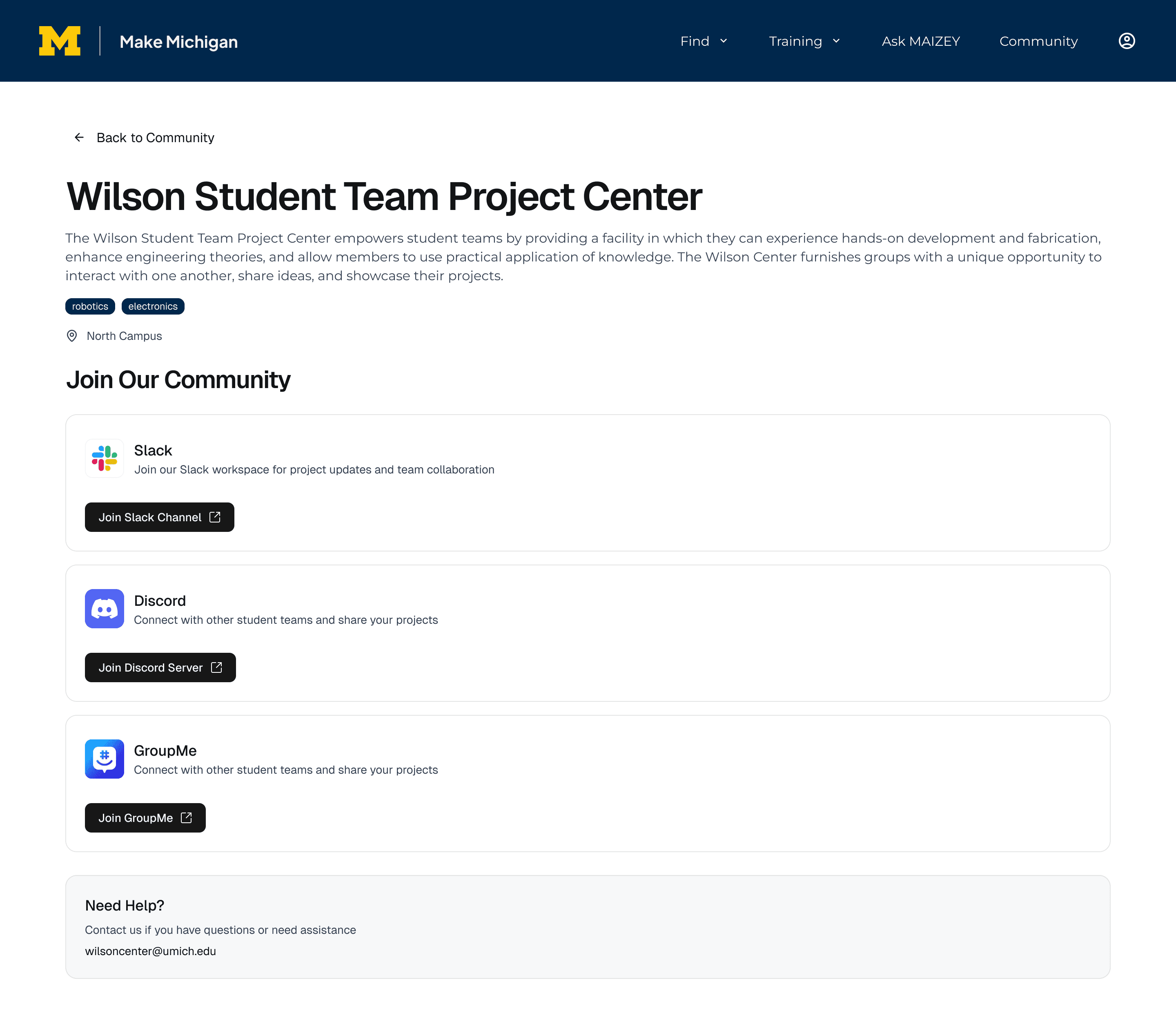
My research, conducted with one other UX designer, became the foundation for five screens across our platform: home, training dashboard, student profile, admin dashboard, and community. I owned the community page end-to-end. My teammates designed the other four, anchored in our shared research findings.
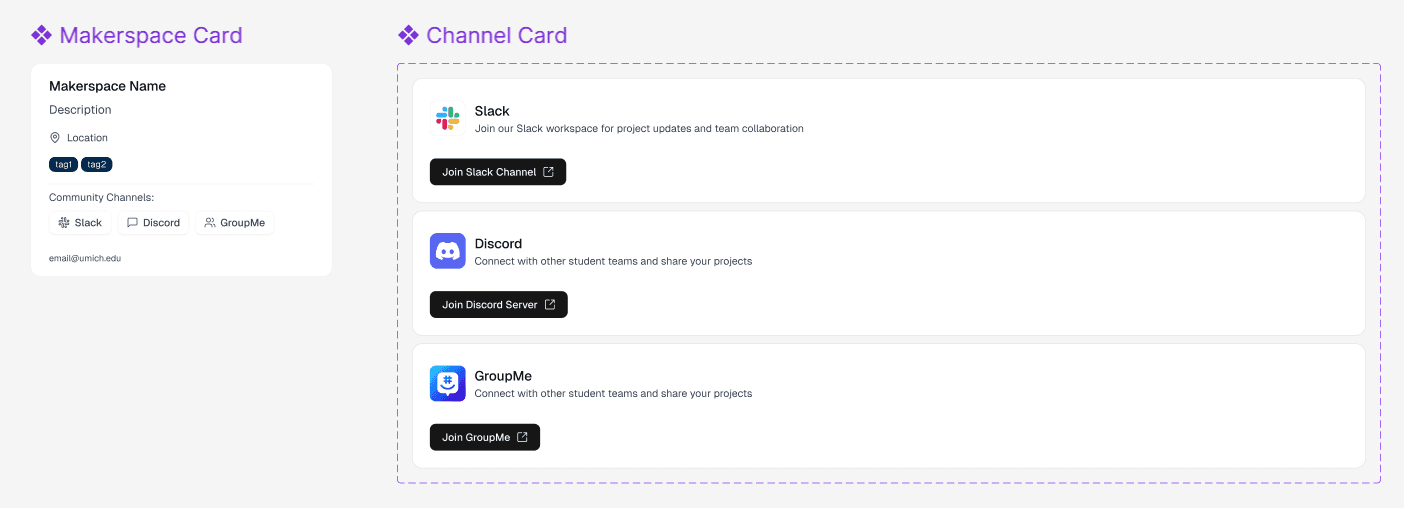
⋆。°✩ COMPONENTS I MADE ✩°。⋆
⋆。°✩ FROM INSIGHT TO MVP ✩°。⋆
DISCOVERY
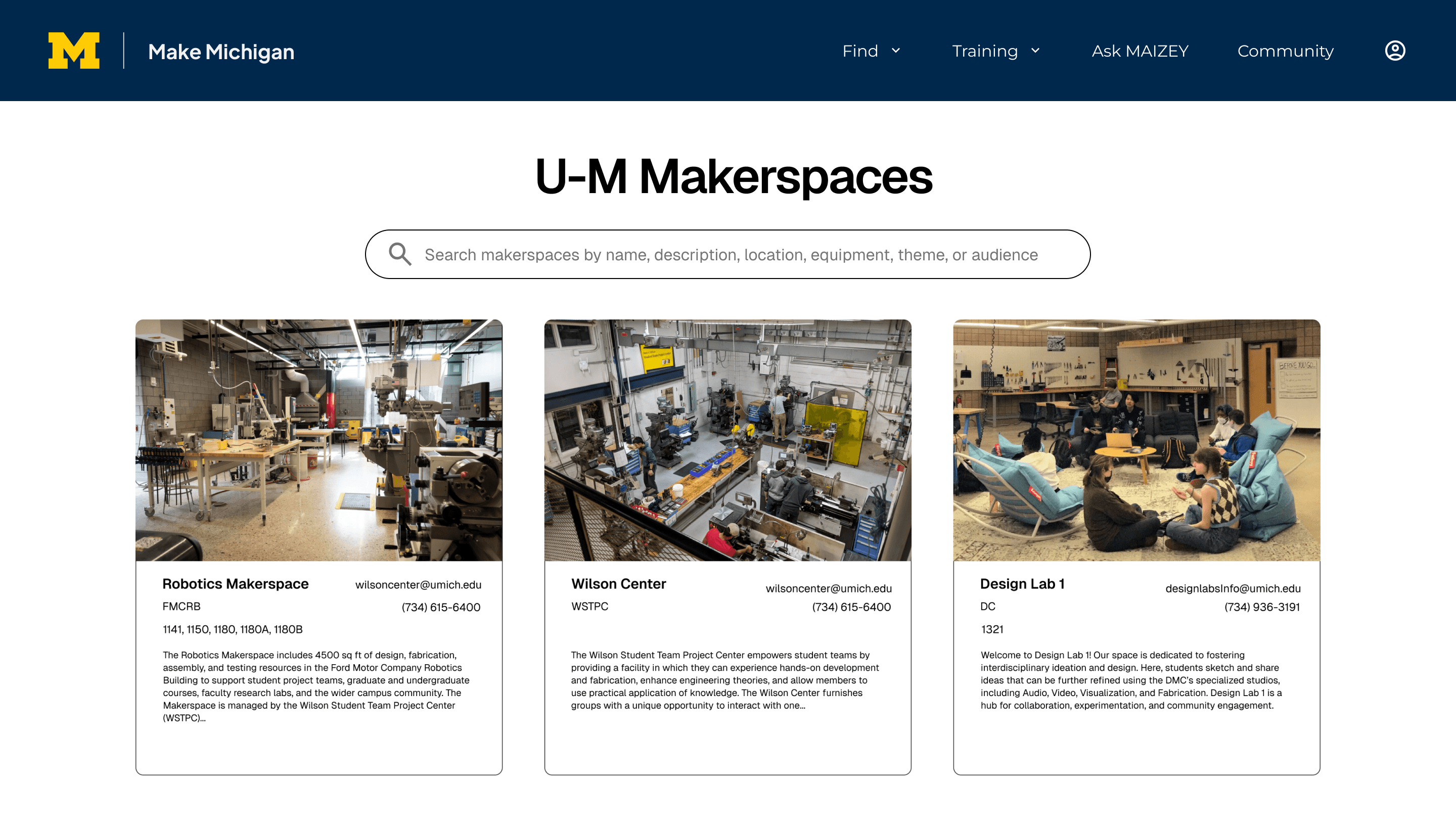
Aggregated discovery page surfacing all makerspaces, links, and resources in one place. Mapping is a future enhancement, not a blocker.
TRAINING
Training dashboard / skill tree showing required sequences, completed trainings, and what each unlocks. Link out before building new.
COMMUNITY
Surface existing Slack, Discord, and GroupMe channels per space. Treat community infrastructure as a first-class feature, not an afterthought.
SCHEDULING
Expose wait times and peak hours. Integrate (not replace) existing booking platforms. Long-term: team calendar coordination.
Expose wait times and peak hours. Integrate (not replace) existing booking platforms. Long-term: team calendar coordination.
DISCOVERY
Aggregated discovery page surfacing all makerspaces, links, and resources in one place. Mapping is a future enhancement, not a blocker.
TRAINING
Training dashboard / skill tree showing required sequences, completed trainings, and what each unlocks. Link out before building new.
COMMUNITY
Surface existing Slack, Discord, and GroupMe channels per space. Treat community infrastructure as a first-class feature, not an afterthought.
SCHEDULING
Expose wait times and peak hours. Integrate (not replace) existing booking platforms. Long-term: team calendar coordination.
✩ Led product direction from open prompt → focused concept
✩ Co-designed core flows and high-fidelity prototype
✩ Defined structure, hierarchy, and interaction model
✩ Drove visual direction and branding
✩ Led and supported qualitative research with students and makerspace staff
✩ Conducted interviews on access, safety, and operational workflows
✩ Synthesized unstructured interview data in Dovetail and Google Sheets
✩ Applied thematic coding to surface recurring pain points
✩ Translated insights into UX requirements, IA, and early Figma designs
✩ Constraints improve clarity
✩ Good UX reduces hesitation, not just friction
✩ Deciding what not to build is the hardest part
✩ Ambiguous qualitative data can become clear design direction
✩ Operational realities matter as much as student needs
✩ The best MVPs surface what exists before building anything new